
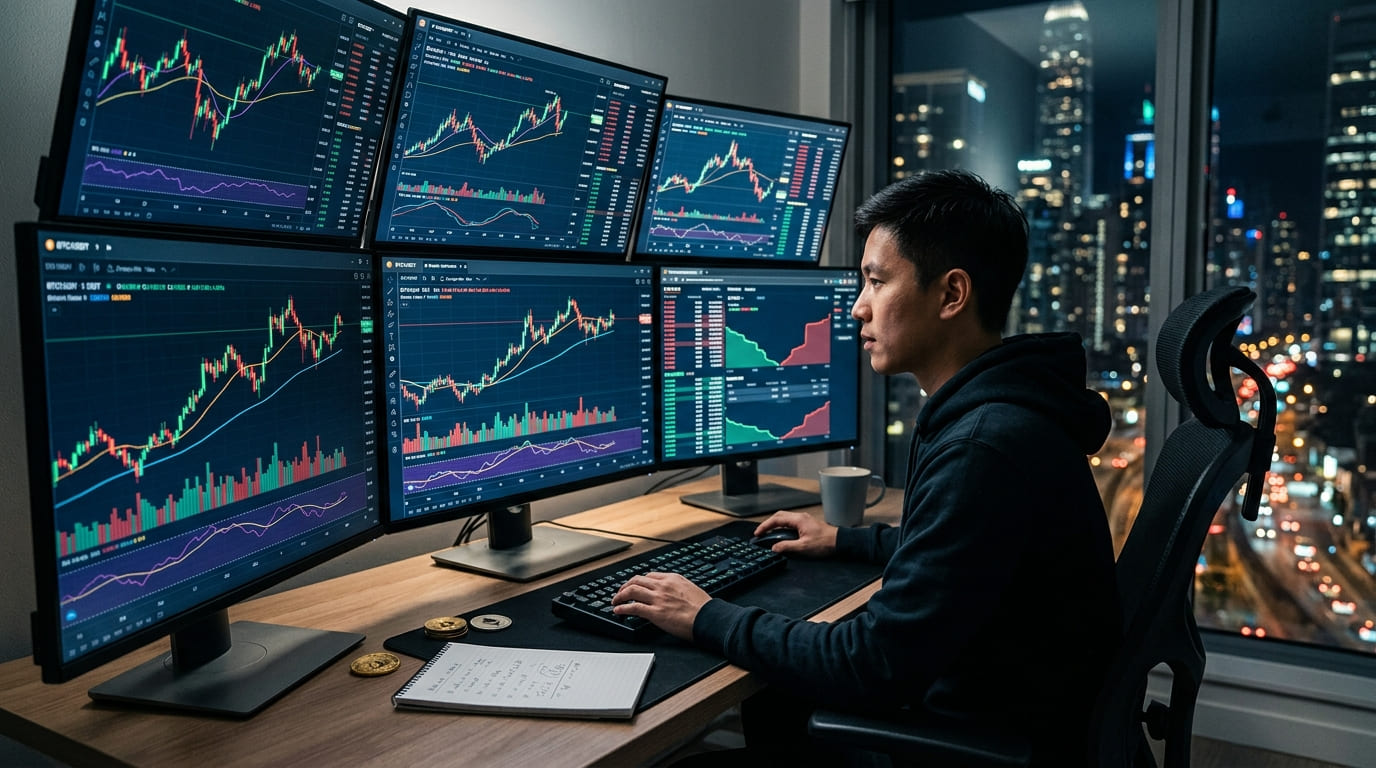
Trading is the buying and selling of financial assets with the aim of profiting from their price movements. The asset can be a stock, a currency, a commodity or, in our case, a cryptocurrency such as Bitcoin or Ethereum.
The logic is simple. If you expect the price to rise, you buy and later sell higher. If you expect it to fall, you can sell (or, with certain products, open a short position) and buy back lower. What is not simple is getting it right consistently, because prices are driven by supply and demand, news, market sentiment and the liquidity available at any given moment.
A person who trades is called a trader. Their job is to make decisions with incomplete information while managing the risk of every position, so that mistakes never knock them out of the market.
Trading vs investing
The two terms are often used interchangeably, but they describe different approaches:
- Time horizon: investing is usually measured in years; trading in minutes, days or weeks.
- Frequency: investors buy and hold; traders enter and exit the market more often.
- Source of returns: investors look for long-term appreciation; traders try to capture price swings in either direction.
- Time commitment: trading requires active monitoring and stricter risk management.
Neither is inherently better. The right choice depends on your goals, the time you have and how much volatility you can stomach. If you are thinking about a long-term approach instead, earning products such as staking may be a better fit than active trading.
Trading styles by holding period
Trading styles are usually grouped by how long positions stay open. Each one demands a different level of commitment and risk tolerance.
Scalping
Trades lasting seconds or a few minutes, aiming for very small gains repeated many times. It requires full focus, fast execution and low fees, since costs weigh heavily when the margin on each trade is tiny.
Day trading
Positions are opened and closed within the same day. In crypto, where the market never closes, the trader defines what a “day” is. It relies mainly on technical analysis and intraday volatility.
Swing trading
Trades held for several days or weeks to capture a leg of a trend. It is one of the most popular styles among people who cannot watch charts all day.
Position trading
Positions held for weeks or months based on broader trends. It sits close to investing, but with entry and exit rules defined in advance.
Ways to trade in the crypto market
Beyond your style, the product you trade matters. Buying Bitcoin is not the same as trading a contract on its price.
Spot trading
You buy or sell the cryptocurrency at the current price and it lands in your account straight away. It is the most direct option: if you buy 0.01 BTC, that 0.01 BTC is yours. A common example is the BTC/USDT pair, where Bitcoin is priced in the Tether stablecoin. You can browse every available pair on Palzea's markets page.
Margin trading
Margin lets you open a position larger than your own capital by using borrowed funds. It magnifies potential gains, but it magnifies losses too, and it carries liquidation risk if the price moves against you.
Futures
Futures are contracts that track the price of a cryptocurrency without you having to own it. They let you go long (betting on a rise) or short (betting on a fall) and are usually traded with leverage. They are complex products aimed at experienced users.
Options
Options give you the right, but not the obligation, to buy or sell an asset at a set price on a set date. Traders use them both to speculate and to hedge other positions. For a primer, see our help centre article on futures and options basics.
Swap and P2P
These are not trading in the strict sense, but many traders use them every day. Swap lets you convert one crypto into another in a few steps, while P2P lets you buy and sell directly with other users.
Key concepts to know before you trade
Before placing your first order, make sure these terms are clear:
- Trading pair: the two assets being exchanged, such as BTC/USDT. The first is what you buy or sell; the second is what you pay with.
- Market order: executes immediately at the best available price.
- Limit order: executes only at the price you set or better.
- Stop loss: an order that automatically closes your position if the price hits a loss level you have defined.
- Take profit: an order that closes the position once it reaches your profit target.
- Spread: the gap between the best buy price and the best sell price.
- Liquidity: how easily an asset can be bought or sold without moving its price too much.
- Fees: the cost of each trade. Always check the fee schedule before trading, as fees directly affect your results.
For a closer look at how each order works, read our guide to order types.
Technical analysis vs fundamental analysis
Traders typically rely on two broad approaches to make decisions.
Technical analysis studies past price and volume behaviour to spot trends, support and resistance levels and chart patterns. It uses candlestick charts, moving averages and indicators such as RSI or MACD. You can practise reading charts on pages like the Bitcoin price or Ethereum price.
Fundamental analysis assesses the value of a project: its technology, real-world utility, tokenomics, the team behind it and the macroeconomic backdrop. In crypto, market cycles also play a big role, including the well-known bull runs.
Many traders combine both: fundamentals to decide what to trade, and technicals to decide when to get in and out.
How to start trading, step by step
- Set your goal and style. How much time can you commit? How much risk can you accept? Your answers will point you towards a style.
- Pick a reliable platform. Look for security, liquidity, transparent fees and support. Our guide to choosing the right crypto exchange can help.
- Create and secure your account. Complete verification and turn on two-factor authentication (2FA).
- Start small. While you learn, only trade with money you can afford to lose.
- Begin with spot. Get comfortable with the spot market before moving to leveraged products. Here is how to place your first spot order.
- Keep a trading journal. Write down why you entered, where you placed your stop and what the outcome was. It is the fastest way to learn from your mistakes.
Trading risks and how to manage them
The crypto market is particularly volatile: prices can move sharply in a short time, at any hour, on any day. That volatility creates opportunities, but it also amplifies losses.
Risk management will not eliminate losses, but it stops one bad trade from wiping out your account. These practices are the foundation:
- Risk a small share per trade. Many traders cap the maximum loss on any single trade at a small percentage of their total capital.
- Always use a stop loss. Decide where you will exit before you enter, not in the middle of the trade.
- Be careful with leverage. A small move against you can liquidate a highly leveraged position.
- Diversify. Do not put all your capital into one asset or one trade.
- Keep emotions in check. Fear and euphoria are poor advisers. A written plan helps you stick to your rules.
Common beginner trading mistakes
- Trading without a plan, based on gut feeling or social media hype.
- Using high leverage from day one.
- Moving the stop loss to give a losing trade “more room”.
- Trying to win back a loss with a bigger trade, also known as revenge trading.
- Ignoring fees, which can eat into a large part of the profit in high-frequency styles.
Trading FAQs
Can you trade with a small amount of money?
Yes. In crypto you can buy fractions of a coin, so you do not need a large amount to get started. The key is making sure fees are not out of proportion to the size of your trades.
Is trading profitable?
It can be, but nothing is guaranteed. A significant share of beginners lose money, especially when they trade without risk management or with high leverage. Profitability depends on discipline, method and experience.
What is the best type of trading for beginners?
Spot trading with a swing trading approach is usually the most manageable place to start: you do not need to watch charts all day and there is no leverage involved.
Do you pay tax on trading profits?
In most countries, yes. Crypto gains usually have tax implications, and the rules vary by jurisdiction. If you are based in Spain, our article on how the Spanish tax agency knows you own crypto is a good starting point, but always check with a tax adviser.
Start trading with Palzea
Palzea brings every way to trade together in one place: spot, margin, futures, options, swap and P2P, with clear fees and tools built for both first-time users and experienced traders. Your account is protected by layers such as two-factor authentication and risk monitoring systems, and the buy, sell and convert flows are designed so you always know exactly what you are doing.
You can start by exploring the available markets or buying your first Bitcoin. And if you have questions along the way, the trading help centre is there for you.
Risk warning: cryptocurrencies are highly volatile assets, and trading, especially with leverage, can result in the loss of all the capital you invest. This content is for information only and does not constitute financial advice. Only trade with funds you can afford to lose.