

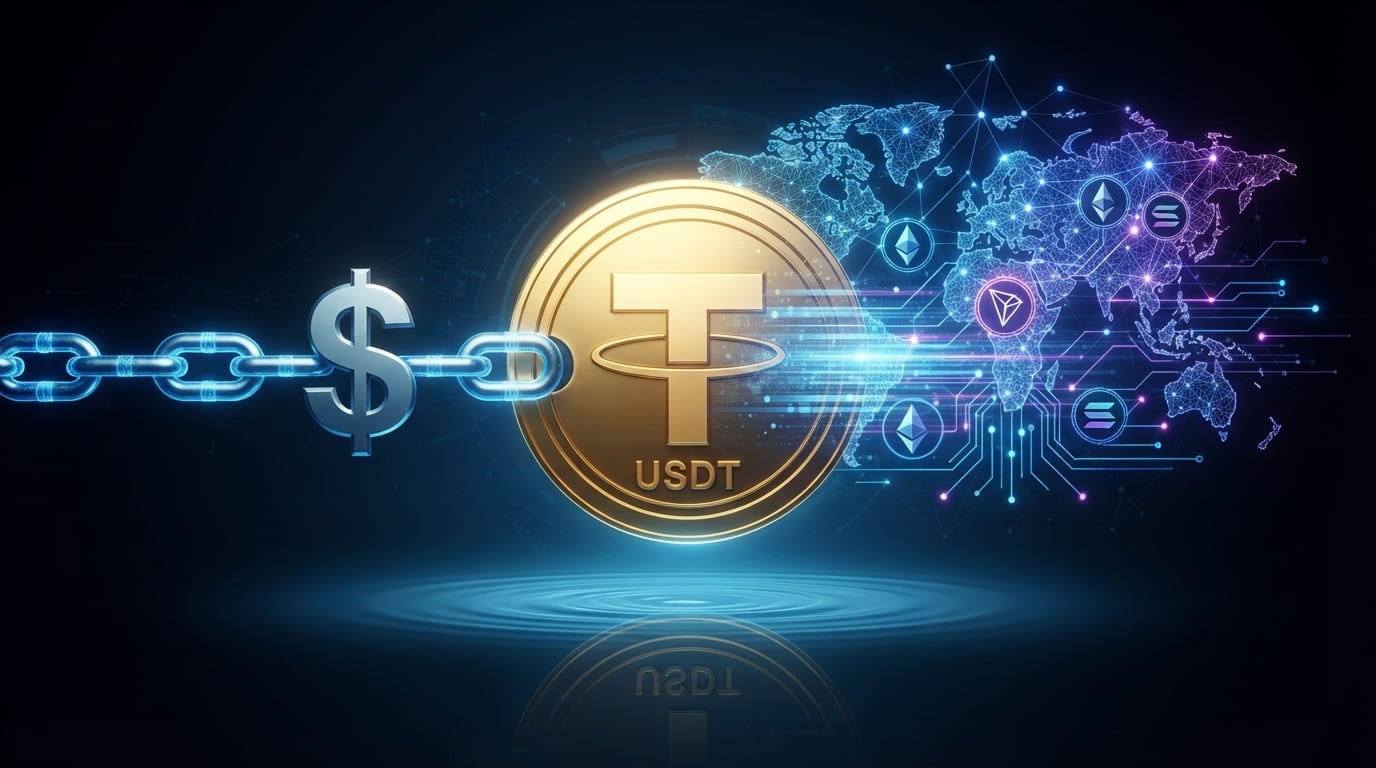
USDT, also known as Tether, is a stablecoin designed to maintain a value close to one US dollar. Its purpose is to combine some of the benefits of cryptocurrencies, including blockchain-based transfers, with greater price stability than cryptocurrencies such as Bitcoin or Ethereum typically provide.
This has made USDT one of the most widely used assets across crypto markets. Traders, investors and everyday users can use it to maintain liquidity, exchange cryptocurrencies, transfer value or temporarily reduce their exposure to market volatility without necessarily leaving the digital asset ecosystem.
However, the fact that USDT is designed to track the US dollar does not make it identical to holding dollars in a bank account. Understanding that distinction requires looking at how Tether works, what backs USDT and what risks are involved.
What is USDT?
USDT is a stablecoin issued by Tether. A stablecoin is a type of digital asset designed to track the value of another reference asset. In USDT's case, that reference asset is the US dollar.
The goal is therefore for 1 USDT to remain worth approximately 1 USD. Unlike Bitcoin, Ether and other cryptocurrencies whose prices can move substantially according to market supply and demand, USDT uses a reserve-backed model together with issuance and redemption mechanisms intended to support its peg.
USDT was originally launched in 2014 and has since become one of the most widely used stablecoins in cryptocurrency markets. You can check the current Tether (USDT) price to see how it is trading at any given time.
What does Tether mean?
The word “tether” means to tie or connect something to another object. The name reflects the fundamental idea behind the asset: connecting the value of a digital token to a traditional currency such as the US dollar.
This is why Tether and USDT are often used almost interchangeably. Technically, however, Tether is the issuer and platform behind the asset, while USD₮ or USDT refers to the token pegged to the US dollar.
How does USDT work?
USDT can be understood through four main elements: reserves, token issuance and redemption, market activity and the blockchains on which USDT operates.
1. USDT targets a 1:1 peg with the US dollar
Tether's model is designed so that USDT in circulation is backed by the issuer's reserves while maintaining a reference value of 1 USDT = 1 USD.
This does not mean that a physical one-dollar banknote is necessarily held for every individual USDT. Tether's reserves can contain several categories of assets, including cash, cash equivalents and other financial assets.
That distinction matters: USDT is a reserve-backed digital token, not an individual US dollar stored in a vault for every token in circulation.
2. USDT issuance and redemption
Tether can issue tokens in response to demand from customers who meet its requirements. Tokens that enter circulation are backed by the corresponding reserves under Tether's model.
The process can also work in reverse. When eligible customers redeem USDT through the issuer, those tokens can be removed from circulation or held in Tether's treasury outside the circulating supply.
This means that USDT does not have a permanently fixed maximum supply like Bitcoin. The amount in circulation can increase or decrease as demand, issuance and redemptions change.
3. Market activity helps keep USDT close to $1
USDT trades freely on cryptocurrency exchanges, so its market price can occasionally move slightly above or below one dollar.
If a sufficient difference develops, market participants may have an incentive to buy or sell USDT to take advantage of that price gap. Issuance and redemption for eligible participants, combined with arbitrage in secondary markets, can help push the price back toward its reference value.
For that reason, it is more accurate to say that USDT is designed to trade around $1 rather than claiming that its market price can never move away from exactly one dollar.
4. USDT operates on multiple blockchains
USDT does not have its own blockchain. Instead, the token is issued on several blockchain networks that process and record its transfers.
USDT is available through networks such as Ethereum, Tron and Solana, among others. The underlying asset is still USDT, but the network used to transfer it can affect compatible addresses, transaction costs and settlement times.
This makes checking the network essential before making a transfer. If you want to move digital assets into Palzea, you can review its guide on how to deposit crypto.
What is USDT used for?
USDT's relative stability against the dollar gives it several practical uses across cryptocurrency markets and blockchain-based payments.
Reducing exposure to crypto volatility
Imagine an investor holds Bitcoin but expects a period of significant market volatility. One option would be to sell BTC for dollars or euros. Another possibility is to temporarily convert it into a stablecoin such as USDT.
This removes direct exposure to Bitcoin's price movements while leaving the user with a digital asset that can be used again within crypto markets.
Trading other cryptocurrencies
USDT is widely used as a quote asset in cryptocurrency markets. Many trading pairs express the value of another cryptocurrency in USDT.
For example, if BTC is quoted at 80,000 USDT, the market is effectively valuing one Bitcoin at approximately 80,000 units of Tether.
On Palzea, you can explore the available cryptocurrency markets and use USDT as part of your trading activity.
Moving between cryptocurrencies without returning to fiat
USDT can also act as a bridge asset. Rather than selling cryptocurrency for fiat currency, withdrawing it and later buying another cryptocurrency, traders may be able to exchange assets directly within the crypto ecosystem.
For example, you can check the USDT to Bitcoin conversion or use Palzea's crypto conversion tool to move between supported assets.
Transferring value through blockchain networks
USDT can be transferred between compatible wallets and platforms using blockchain infrastructure. This allows users to move a dollar-linked unit of value without relying on a conventional bank transfer.
Transaction speed and cost do not depend on USDT alone. They are largely determined by the blockchain being used and its network conditions at the time.
Payments and international transfers
Some individuals and businesses use stablecoins to settle transactions, receive payments or move funds internationally. A dollar-linked asset that can travel through blockchain networks can be useful in these situations.
However, the legal, tax and regulatory treatment of stablecoins can vary by country, so users should always check the rules that apply in their jurisdiction.
Is USDT the same as the US dollar?
No. USDT and USD are not exactly the same thing.
The US dollar is a fiat currency issued within the United States monetary system. USDT, on the other hand, is a digital token issued by a private company that aims to track the dollar through reserves and market mechanisms.
Holding 1,000 USDT therefore does not necessarily carry the same legal characteristics or protections as holding $1,000 in a bank account.
USDT also introduces risks that differ from conventional bank deposits, including issuer risk, custody risk, blockchain network risk and the possibility of a temporary loss of its dollar peg.
USDT vs Bitcoin: what is the difference?
Although both are digital assets, Bitcoin and USDT were created for very different purposes.
Bitcoin has a maximum supply defined by its protocol and its market price moves freely according to supply and demand. There is no central company responsible for keeping BTC at a particular price.
USDT operates under a more centralized model in which Tether is the issuer and the token is designed to stay close to one US dollar.
Bitcoin is therefore commonly used as an investment asset, digital store of value or transfer mechanism whose price can fluctuate substantially. USDT is more commonly used for liquidity, trading, transfers and short-term price stability within crypto markets.
USDT vs USDC: what is the difference?
USDT and USDC fall into the same broad category: both are stablecoins designed to track the US dollar. They are, however, issued by different organisations and differ in areas such as reserve management, operational policies, liquidity, supported networks and regulatory treatment.
There is no single stablecoin that is automatically the best option for every user. The most suitable asset can depend on the exchange being used, the destination blockchain, available liquidity and the purpose of the transaction.
If you need to move between the two stablecoins, Palzea provides a dedicated USDT to USDC conversion page.
How to buy USDT
One of the most common ways to acquire Tether is through a cryptocurrency exchange.
On Palzea, you can visit the page to buy USDT, choose the amount you want and review the options available to complete the purchase.
Before confirming any transaction, check the quoted price, final amount, applicable fees and the network you intend to use if you plan to withdraw your tokens later.
Where can you store USDT?
USDT can be held through an exchange account or transferred to a compatible crypto wallet.
Custodial wallets
With a custodial solution, a platform manages the private keys required to access the assets. This can be convenient for users who trade regularly, but it also means trusting a third party with custody of the funds.
Non-custodial wallets
A non-custodial wallet gives the user control over their private keys or recovery phrase. This provides greater direct control but also greater responsibility: losing a recovery phrase can result in permanent loss of access to the assets.
If you decide to move USDT away from a platform, always verify both the destination address and the selected network. Palzea also provides information on how to withdraw crypto.
Which network should you use to send USDT?
There is no network that is automatically best in every situation. The correct choice depends first on which networks are supported by both the sending platform or wallet and the receiving platform or wallet.
Before transferring USDT, verify four things: the sending network, receiving network, destination address and estimated transaction fee.
Two platforms may both support USDT without supporting exactly the same blockchain networks. Sending tokens through an unsupported network can make recovery difficult or, in some cases, impossible.
For a significant transfer, making a small test transaction first can reduce the risk of an expensive mistake.
Advantages of USDT
USDT's main advantage is its ability to provide a relatively stable unit of value within crypto infrastructure.
- Lower price volatility: it is designed to remain close to one US dollar.
- Trading utility: users can move in and out of crypto positions without necessarily converting to fiat.
- Liquidity: USDT is widely used across cryptocurrency markets.
- Multi-chain availability: it can operate on several blockchain networks.
- Transferability: USDT can be moved between compatible wallets.
- Useful pricing unit: it provides a dollar-like reference for valuing other crypto assets.
Risks of USDT you should understand
The word stablecoin can make an asset sound risk-free. USDT is not risk-free. Its price is generally much less volatile than assets such as Bitcoin, but several important risks remain.
Depegging risk
USDT can temporarily trade away from one dollar. A significant or prolonged loss of market confidence could potentially create a larger deviation.
Issuer and reserve risk
USDT depends on Tether and on the issuer's ability to maintain sufficient reserves relative to the tokens in circulation. The composition, custody and transparency of those reserves are therefore relevant considerations when evaluating the asset.
Custody risk
Holding USDT through an exchange or another custodial service also exposes you to risks associated with that provider. Using a self-custody wallet gives you greater control, but security then depends heavily on how well you protect your own keys.
Network risk
Blockchain transfers are generally irreversible. Using the wrong address or an incompatible network may result in tokens becoming inaccessible.
Fraud and phishing risk
Because USDT is widely used, it also frequently appears in scams. Never give anyone your private key or recovery phrase, and carefully verify websites and destination addresses before transferring funds.
Regulatory risk
Stablecoin regulation continues to evolve and differs between jurisdictions. Regulatory changes can also affect which stablecoins, services or features are available on particular platforms.
Can you stake USDT?
USDT does not have native staking. It is not the native asset of a Proof of Stake blockchain where holders lock USDT itself to directly validate the network.
Third-party services may offer returns for lending, supplying liquidity or depositing USDT, but these activities are different from native staking and introduce additional risks such as counterparty risk, protocol risk and smart contract risk.
Is USDT safe?
No financial asset is completely free from risk. USDT has been widely used across cryptocurrency markets for years, but its stability still depends on several factors: the issuer's reserves, market confidence, blockchain infrastructure, custody arrangements and the regulatory environment.
Users can reduce operational risks by understanding how USDT works before buying it, choosing trusted platforms, enabling security measures such as two-factor authentication, carefully checking deposit and withdrawal networks and protecting private keys when using self-custody.
Frequently asked questions about USDT
What is USDT in simple terms?
USDT is a stablecoin issued by Tether that is designed to remain worth approximately one US dollar. It can be transferred through several blockchain networks and is widely used for trading, liquidity and moving value.
Is 1 USDT always worth $1?
Not necessarily. One dollar is its target value, but USDT trades on open markets and its price can move slightly above or below $1.
Does USDT have its own blockchain?
No. USDT exists as a token on several supported blockchains. This is why choosing the correct network is essential whenever tokens are deposited, withdrawn or transferred.
Can USDT increase in price like Bitcoin?
That is not its purpose. USDT is specifically designed to avoid major price movements and stay close to $1. Buying USDT in the expectation that its price will appreciate substantially would conflict with the basic purpose of a dollar-pegged stablecoin.
What is the difference between USDT and USD?
USD is the official fiat currency of the United States. USDT is a digital token issued by Tether and backed by reserves with the goal of tracking the value of the dollar.
Can USDT be converted into other cryptocurrencies?
Yes. USDT is commonly used as a trading asset and can be converted into other cryptocurrencies supported by an exchange. On Palzea, you can explore available markets or use the crypto conversion tool.
Can you lose money with USDT?
Yes. Although it is designed to be less volatile than cryptocurrencies such as Bitcoin, USDT still involves depegging, counterparty, custody, transfer, cybersecurity, fraud and regulatory risks.
Conclusion: why is USDT important in crypto?
USDT acts as a bridge between the value of the US dollar and blockchain infrastructure. By targeting a price close to $1, it gives cryptocurrency users a relatively stable unit that can be used for trading, transferring funds and maintaining liquidity within digital asset markets.
Its structure, however, is very different from a decentralized cryptocurrency such as Bitcoin. USDT depends on an issuer, its reserves and the blockchain networks through which the tokens circulate.
Understanding those differences makes it easier to use Tether appropriately. Before making a transaction, check the price, selected network, applicable costs and associated risks. If you want to explore USDT on Palzea, you can check the current Tether price or go directly to the page to buy USDT.