


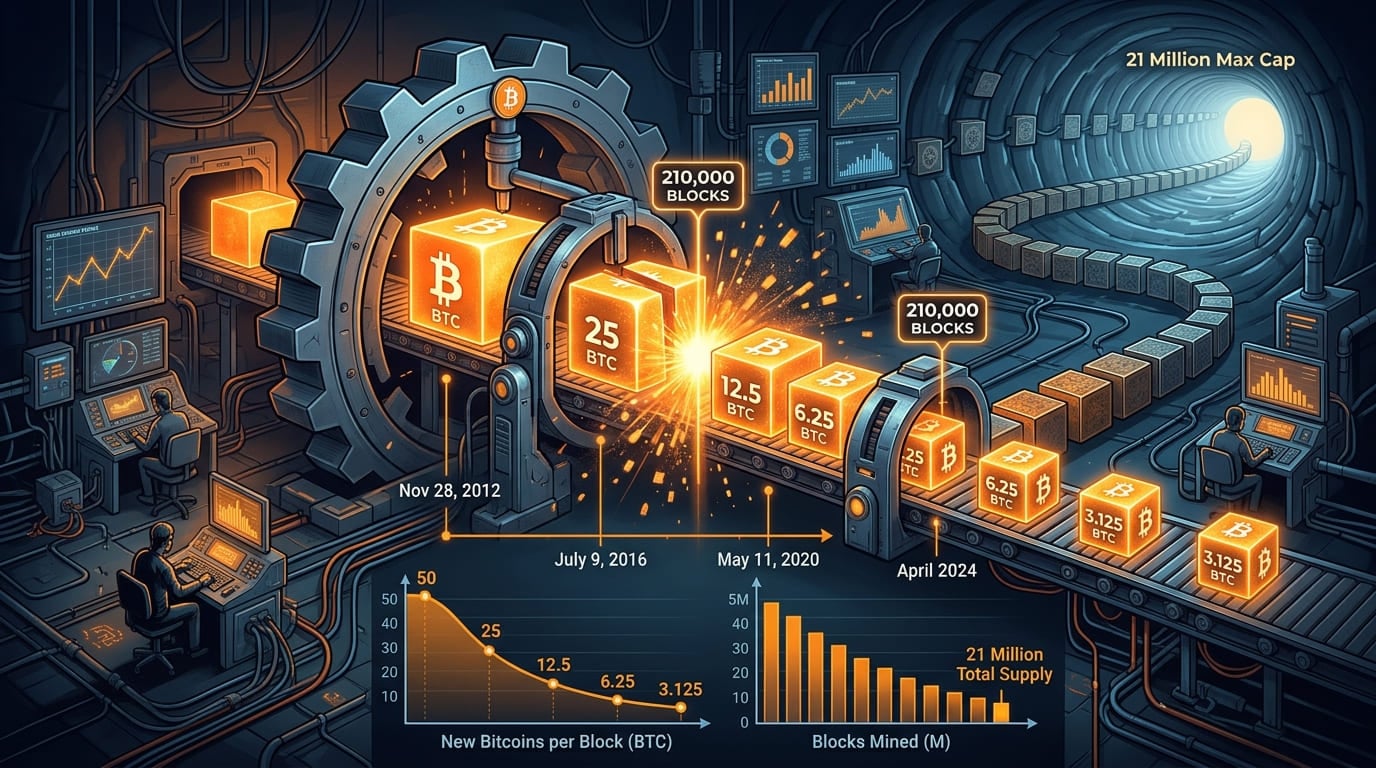
Bitcoin halving is a scheduled event built into the Bitcoin protocol that cuts the reward miners receive for adding a new block by 50%. It happens every 210,000 blocks, roughly once every four years, and it is one of the main mechanisms that keeps Bitcoin's supply limited to 21 million coins.
This guide explains what halving is, why it exists, how it works, how many there have been, when the next one is expected, and what is (and isn't) known about its relationship with price. It is educational content, not financial advice, and crypto assets are highly volatile.
What is Bitcoin halving?
No bank or company issues Bitcoin. New coins are created as payment to miners, who validate transactions and group them into blocks. Every valid block earns the miner a block reward, made up of newly issued bitcoins plus the fees from the transactions included.
Halving simply means cutting that new-coin reward in half. The protocol does it automatically after a fixed number of blocks, and nobody has to approve or trigger it. If you want more background, you can read about how blockchain works and what cryptocurrency mining involves.
Key points at a glance
- Halving happens every 210,000 blocks, around every four years.
- It slows down how fast new bitcoins enter circulation.
- It does not change your balance or how your transactions work.
- Its effect on price is debated and never guaranteed.
Why does Bitcoin have halvings?
Halving is part of Bitcoin's monetary design. It serves three main purposes:
- Capping supply: there will never be more than 21 million bitcoins. Halving spreads their issuance over many decades instead of releasing everything early on.
- Making issuance predictable: anyone can calculate how many new coins will be created at each stage, unlike traditional money, whose supply depends on central bank decisions.
- Building in scarcity: as the pace of new coins keeps falling, each stage is scarcer than the last, an idea often compared to precious metals.
How Bitcoin halving works
Blocks and rewards
The Bitcoin network is designed to produce one block about every ten minutes on average. Once 210,000 blocks have been mined, the block reward is cut in half. Because that number takes roughly four years to reach, halvings are tied to that cycle.
Why the date is never exact
Blocks are not mined at exactly ten-minute intervals, because the network's computing power changes over time. To keep the pace steady, the protocol adjusts mining difficulty every 2,016 blocks. That is why halving is defined by block count rather than by calendar date, and why the exact day can only be predicted accurately when it is close.
What happens on halving day
From the outside, very little. The network keeps running, there is no pause and transactions work as usual. From that block onward, new blocks simply pay miners half as many new bitcoins as before.
Bitcoin halving dates and rewards so far
There have been four halvings to date:
- First halving (November 28, 2012): the reward dropped from 50 to 25 BTC per block.
- Second halving (July 9, 2016): from 25 to 12.5 BTC.
- Third halving (May 11, 2020): from 12.5 to 6.25 BTC.
- Fourth halving (April 2024, block 840,000): from 6.25 to 3.125 BTC.
Each one took place in a different market environment, with different levels of adoption, regulation and economic conditions, so direct comparisons between cycles should be made with caution.
When is the next Bitcoin halving?
Estimates place the next halving around 2028. It is expected at block 1,050,000 and will lower the reward from 3.125 to 1.5625 BTC per block. The exact date cannot be known far in advance, since it depends on how quickly blocks are actually mined between now and then.
Halvings will continue until the last bitcoin is issued, projected for around the year 2140. After that, miners will rely only on transaction fees.
What does halving mean for miners, users and the market?
For miners
Miners feel it most directly, since they earn half as many new coins per block. Whether mining stays profitable depends on Bitcoin's price, electricity costs and equipment efficiency. Less efficient operations may shut down, and difficulty then readjusts to keep block times stable. Over the long run, transaction fees become a bigger share of miner income.
For everyday users
If you buy, send, receive or hold bitcoin, halving does not require any action and does not change how your wallet or transactions work. It affects the creation of new coins, not the ones that already exist.
For the market and price
This is where expectations, and confusion, run highest. The theory is straightforward: if fewer new coins enter the market while demand holds or grows, price could benefit. Some past halvings were followed by strong market phases, which is a big reason the event gets so much attention, much like the talk around a crypto bull run.
But there are important caveats. There are only four events to compare, today's market is shaped by regulation, liquidity and the wider economy, and many investors may anticipate the event and price it in beforehand. One event following another does not prove it caused it. Volatility also tends to increase around halving, in both directions.
Common myths about Bitcoin halving
- "Halving always pushes the price up": there is no guarantee. It is one supply factor among many.
- "Halving destroys bitcoin": no existing coins are removed; only the pace of new issuance slows down.
- "Mining stops after halving": mining continues until the last bitcoin is issued, with smaller rewards and a growing role for fees.
- "Halving affects my coins or transactions": it does not. Your balance and transfers stay the same.
How to manage risk when halving dominates the headlines
Widely discussed events often come with sharp price moves and a lot of noise. A few general ideas to avoid acting on impulse:
- Set a plan before you trade: how much you are willing to allocate, over what time horizon, and what loss you can accept.
- Use protective orders: understanding the different order types can help you limit losses instead of reacting in the heat of the moment.
- Don't invest on headlines alone: a known, scheduled event does not remove market uncertainty.
- Avoid money you may need soon: volatility can be high.
If you are just getting started, this beginner's guide to choosing a crypto exchange is a good next read.
Following the Bitcoin market on Palzea
If you want to keep an eye on Bitcoin, Palzea lets you check the Bitcoin price, go to the Buy Bitcoin page, or explore trading pairs in the markets section. Before trading, it is also worth reviewing the applicable fees.
Security matters in any trading routine. Turning on two-factor authentication is one of the basic ways to protect your account, and Palzea works with clear flows and risk monitoring so that trading stays transparent.
Frequently asked questions about Bitcoin halving
How often does Bitcoin halving happen?
Every 210,000 blocks, which works out to roughly four years. The real interval can vary slightly depending on mining speed.
How many halvings have there been?
Four so far: in 2012, 2016, 2020 and 2024.
What is the current block reward?
Since the fourth halving it has been 3.125 bitcoins per block, and it will stay that way until the next halving.
When is the next Bitcoin halving?
It is estimated around 2028, when block 1,050,000 is reached. The exact date cannot be fixed in advance.
How many bitcoins are left to mine?
Most of the 21 million are already in circulation. The rest will be issued at a progressively slower pace until around 2140. For an exact, up-to-date figure, check a blockchain explorer [DATO A CONFIRMAR].
What will Bitcoin be worth after the halving?
Nobody can know. Price depends on many factors besides supply, and comparisons with past cycles do not guarantee future results.
Do other cryptocurrencies have halvings?
Yes. Some networks with a similar design, such as Litecoin, include reward-reduction mechanisms, though each follows its own schedule and rules.
Does halving affect my bitcoin or my transactions?
No. Halving only changes what miners earn for new blocks. It does not alter user balances or how funds are sent and received.
Final thoughts
Bitcoin halving is an automatic mechanism that cuts the pace of new issuance in half every 210,000 blocks. Understanding it helps you make sense of the news and the debate around Bitcoin, but it does not replace your own research or remove risk. If you want to follow the market, you can do it on Palzea with clear information and a calm approach.
Risk warning: cryptocurrencies are highly volatile assets and you may lose some or all of the capital you invest. This content is for information only and does not constitute financial advice or an investment recommendation.